
Don’t you
love it when the Lectionary starts with a line like, “Six days later”? In case
you were wondering what happened six days ago, it was when Peter declared that
Jesus was the Messiah, the Son of the Living God…and shortly thereafter got on
Jesus’ case for saying he would have to die and got called Satan for his
trouble. So stuff is getting real at this point in the story. Jesus is getting
ready to head for Jerusalem where, he knows, death is waiting.
The New
Orleans custom called Second Line expresses the ultimate joy of earthly death,
that even when we are gone from this world, resurrection awaits. If you like,
we could think of Palm Sunday as a kind of Second Line, a demonstration of
jubilation in the face of doom. This was a critical idea for Black people in
Louisiana for so many centuries. When your daily walk is through the valley of
the shadow of death, it is healthy to believe that this abysmal world with its
cruel masters and massive oppression is not the last word of God’s creation.
And the good news is, it isn’t. At some time unknown, this will all culminate in
what Bruce Cockburn’s song calls a “Festival of Friends,” a great Carnival of
diversity to which all are invited—as long as they are willing to leave their
hate at the door.
Carnival or
Mardi Gras, rightly observed, is a time when we get a taste of this festival of
friends. All things are permitted. Everyone is welcome. Even the disapproval of
earthly religion can’t touch its liberty. There is no judge but Jesus, and he
isn’t judging. He’s partying with us. This is the time when the dishwater turns
to fine wine. When bodies are celebrated, not shamed. When we are invited into
the sensory cathedral that is God’s good Earth.
It is an
example of what novelist and theologian Charles Williams called the Way of
Affirmation of Images, this embracing of the material universe as a reflection
of its Creator. Its counterpoint is the Way of Negation, the idea that nothing
in Creation is adequate to reflect the grandeur of God and should therefore be downplayed.
Williams argued for holding these two ideas in balance at the same time. He wrote
that when looking at, say, a work of art or a sunset or a beloved person, we
can say to God, “This is thou. This also is not thou.”
For much of
our history, the Church has leaned into the Way of Negation, teaching us to be
suspicious of everything earthly and earthy. Confession was mandatory. Ascetics
were celebrated. Lent was emphasized. The Puritans plastered over priceless
frescoes in English churches, viewing them as mere idols. But there is a
difference between an idol and an icon. An idol, like the golden calf the
people were found worshiping when Moses comes down from the mountain the first
time, is a coward’s substitute for the ultimate reality of God’s self, while an
icon shows something important about that reality at the heart of the universe.
Moses became a living icon when he came down from the mountain the second time with
his face, as we recall, shining and transfigured from having seen God’s
hindquarters.
The upcoming
season of Lent allows us to explore the Way of Negation, but its precursor,
Carnival, gives a chance to live for a little while in the Way of Affirmation.
In my
experience performing with masks, I’ve found that something real about me comes
out, often a side I didn’t know was there, when my face is transfigured. In
Italian traditional comedy, there are stock characters who wear masks:
Pantalone the rich miser, il Dottore the overeducated pedant, Capitano the
cowardly warmonger, various servant figures and, most famously, Arlecchino or
Harlequin, the holy Fool. Each represents an exaggerated aspect of the human
condition. These Masks frequently come out to play during the Carnival season,
some as performers in improvised plays and many as random people among the
crowds, revealing that all of us, complete with our foibles, are part of the
final celebration. A mask brings out this truth of radical acceptance. All, ALL
are invited to the Festival of Friends.
Those
traditional Masks are icons for me. Even when I was playing Pantalone and what
was revealed was less than flattering, it was good for me to find it. When
we’re transfigured, we are visible. More visible, I would argue, than in our
everyday faces. Like, when my trans friend Luka wears his chest binder, by
concealing a body part, he looks more like his true self.
Many people
think of masks as a way to allow people to misbehave with impunity. I’m sure
some are. We see this dark side of masks with masked Immigration officers whose
worst impulses are let loose when their faces are obscured. But that is not the
proper purpose of the Mask. There is no joy in those ICE masks, no affirmation,
only negation. If your soul is full of hate, that is unfortunately what the
mask will reveal.
But if your
soul is full of joyful embrace, it is possible for that to be fully released
when your everyday outward appearance is altered. You can be free from the
constraints of conformity to this world’s skewed norms. Behind masks of
anonymity, we are free to be more ourselves. This is the paradox of the Mask.
When your fleshly face is covered, your true face can come out, and you can, sometimes,
more clearly hear God calling you his beloved.
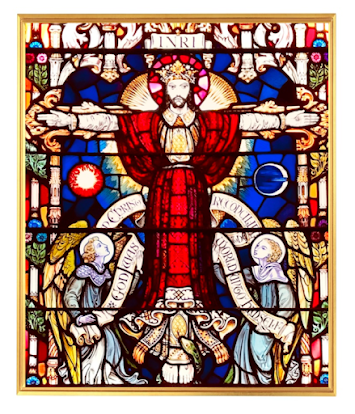
When Jesus
started glowing on that mountaintop, the truth of his nature was unmasked, and
it was more beautiful than his friends could have imagined. His everyday
appearance, the face Peter, James and John were familiar with, was the real disguise.
And here’s the amazing thing: we can all be icons. We can all reveal Truth. We
can all light up the mountain.
So I brought
some Carnival masks. Nothing fancy, but they will make your face shine a little,
like Moses’ coming down from Sinai. Help yourselves. Be transfigured for a few
minutes. Soon we will form a Second Line and process around the church. Let’s get
transfigured. Let’s shine.
Comments
Post a Comment